Visuals
Reading a corridor
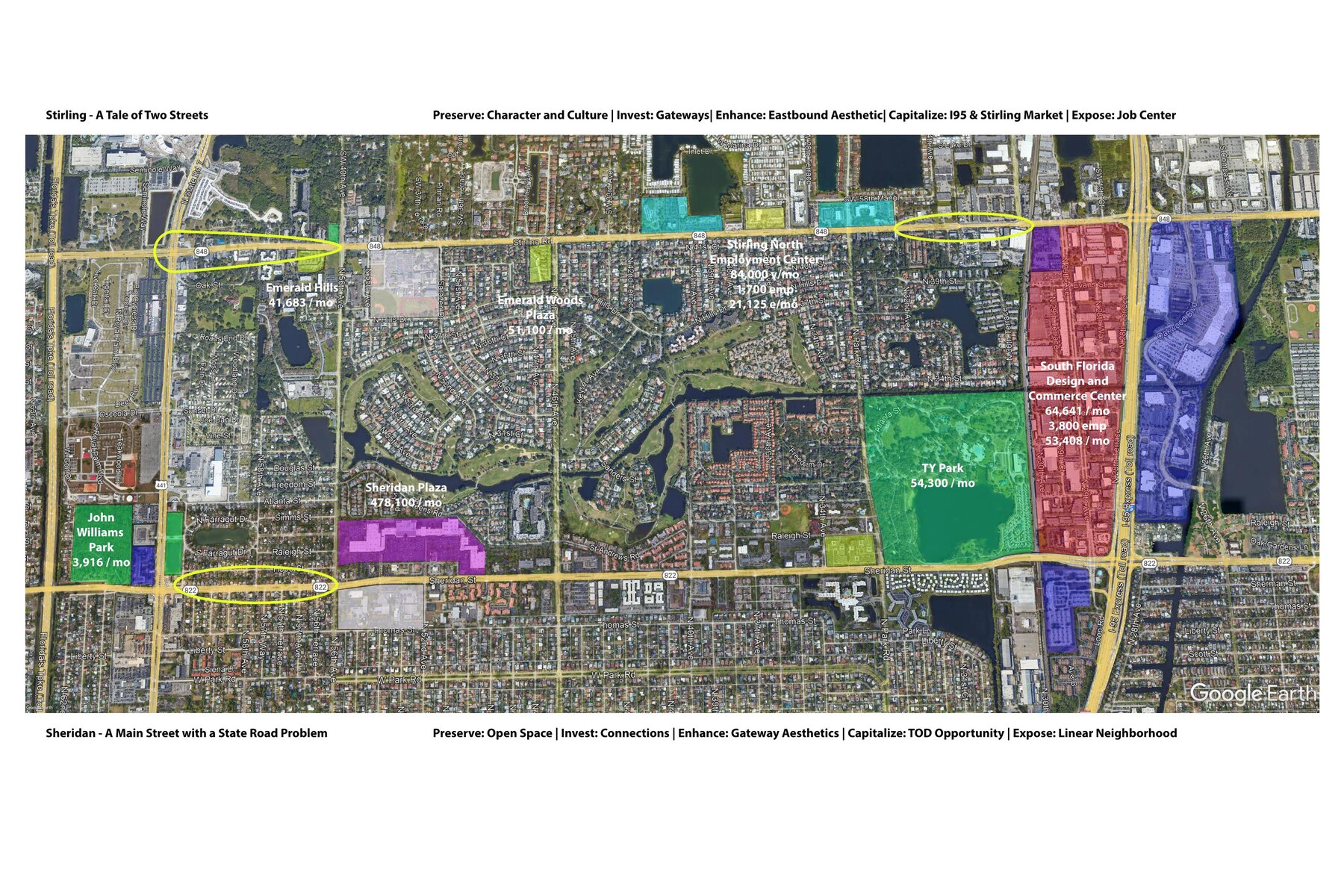
A corridor-by-corridor economic-development assessment that reads the #FlareFactor of Hollywood's four commercial spines — pairing CoStar market data, Placer.ai foot traffic, and a Placer/ESRI/Mosaic void analysis into a targeted playbook for investment, branding, and placemaking.
The City's Office of Communications, Marketing and Economic Development engaged BusinessFlare® to assess its four principal commercial corridors and define each one's unique character — what the firm calls the #FlareFactor. Rather than treating them as interchangeable retail strips, the assessment gave each a distinct identity: SR 7 / US 441 as Local Flavor, Sheridan/Stirling as Neighborhood Commercial / Destination, Dixie/Federal as Cool-Hip-Artsy-Vintage-Boutique, and Hollywood Blvd / Pembroke as Civic Center / Office.
Each corridor profile combines a CoStar real-estate read (vacancy, rents, sale prices, cap rates), Placer.ai foot-traffic trends and trade areas, demographics, and an on-the-ground business inventory. A companion void / retail-gap analysis — built from Placer.ai, ESRI, and Mosaic data across five key sites — pinpoints the specific tenant types each location could realistically capture, turning character into an actionable investment, branding, and placemaking playbook.
Each corridor possesses a distinct character the City can build on — and by understanding those identities, Hollywood can strategically target investments, incentives, and marketing rather than applying a one-size-fits-all approach. Food corridors can be leveraged for culinary tourism; art and boutique corridors optimized for cultural events and foot traffic; civic corridors positioned as professional-services hubs. The strategy rests on four moves repeated across every corridor: targeted investment, distinct branding, community engagement, and infrastructure improvements.
Four commercial spines, each with its own character, market data, and recommendations — plus the void-analysis method that ties them together.
A 4.6-mile north-south corridor on the City's west side, home to the $1.5B Guitar Hotel at Seminole Hard Rock. It carries the County's highest transit ridership and earned a Transit-Oriented Corridor designation, backed by $200M in FDOT roadway work and $12.1M in utility upgrades. The strategy: preserve the local-flavor food niche, capture casino visitors, and add non-intrusive mixed-use infill.
A 3.5-mile east-west corridor between I-95 and SR 7, blending quality residential neighborhoods with regional destinations: the South Florida Design & Commerce Center, the Sheridan Street Tri-Rail station, the Yellow Green Farmers Market, Oakwood Plaza (~900,000 SF), and T.Y. Park. Strategy: preserve character and open space, invest in gateways, and unlock TOD.
Broken into north and south sections. The north is anchored by two Publix stores near downtown and ArtsPark at Young Circle; the south carries boutique hotels, auto shops, and emerging creative/maker businesses. The play: build a branded creative district, a linear park along the FEC line, and capture casino traffic.
Hollywood Boulevard is the City's civic and cultural axis — City Hall, the Courthouse, the Police Department, and Memorial Regional Hospital create a medical/legal professional niche with Tri-Rail and I-95 access. Pembroke Road, the southern boundary, is auto/industrial but transforming. Strategy: brand the Boulevard as a professional-services hub and soften Pembroke with streetscape and neighborhood retail.
BusinessFlare® ran a void (retail-gap) analysis across five key Hollywood sites, built from Placer.ai foot-traffic data, ESRI demographics, and Mosaic household segmentation. Each candidate operator is scored on demographic fit, cannibalization risk, traffic potential, store-size fit, and expansion rate — so recommendations reflect what a site can realistically attract.